
Use Case: How Biontec decreased post-processing time and labor costs using sallea’s salt cores

Moving beyond machined foam cores
For its industrial CFRP robot arm parts, Biontec uses machined foam cores that partially remain inside the final component. Due to the complex shape of the parts, a foam core is needed so that the stichted carbon-fiber textile (TFP) can be wrapped around it during manufacturing. While this process works, it adds unnecessary steps to both the pre- and post-processing of the CFRP part. This increases manual processing time and results in high manufacturing costs.
Moreover, the foam cores limit fully hollow and lightweight designs. After manufacturing, the core is removed by machining as far as possible. However, not all areas can be reached, meaning that parts of the foam core remain inside the final component.
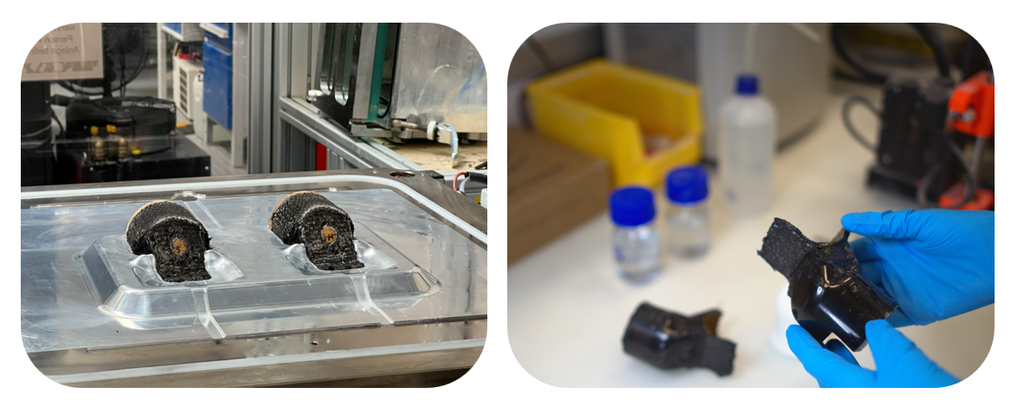
From left: manufacturing of CFRP parts at Biontec‘s facility, first prototypes from the project.
Introducing removable cores into RTM processing
Together, sallea and Biontec tested sallea’s customized 3D-printed salt cores as a direct replacement for machined foam cores in Biontec’s RTM process. The cores were printed and sealed in the desired shape before being wrapped with the stichted carbon-fiber textile (TFP). The wrapped cores were then placed in the metal mold and processed using Biontec’s RTM process.

The first trials proved that the concept works and that the weight of the final carbon part can be reduced by completely removing the core. Moreover, Biontec achieved a 15% reduction in post-processing time and a 6% reduction in labor costs by completely removing the core.
From process improvement to scalable industrial production
The collaboration is now moving into the next phase, focused on improving surface finish and increasing process stability. The results show strong potential for using sallea’s saltBASE cores in repeatable, scalable industrial CFRP production.